Review: The Unbelievers at Royal Court Theatre
⭐⭐⭐⭐ (Four Stars)
The Unbelievers, a new play written by Nick Payne and directed by Marianne Elliott, provides an intriguing and enthralling exploration of a family in the wake of tragedy. When teenage Oscar goes missing without trace, the Wright family oscillates between hope and hopelessness, grieving a loved one despite not knowing whether he is dead or alive. The timeline shown to the audience jumps backwards and forwards between the first week after Oscar’s disappearance, one year later, and seven years later, allowing us to witness how each family member responds to the devastating loss over time.
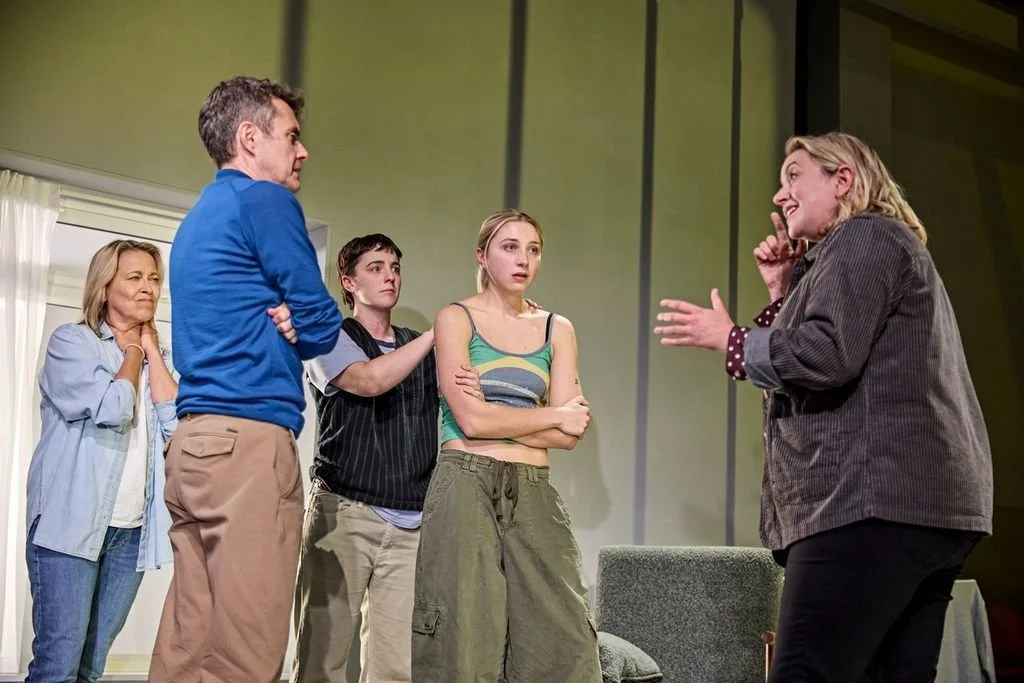
Oscar’s mother, Miriam (Nicola Walker), is overwhelmed by grief and caught in a cycle of following any potential thread of evidence, no matter how tenuous, that might shed light on Oscar’s whereabouts since she cannot bring herself to consider that he might no longer be alive. Oscar’s eldest sibling, Nancy (Alby Baldwin), however, turns to the supernatural in an attempt to understand what has happened whilst Nancy’s father, Karl (Martin Marquez), who has become a vicar since his separation from Miriam, attempts to support the family through his Christian faith. Meanwhile, Oscar’s father, David (Paul Wright), and sister, Margaret (Ella Lily Hyland), attempt to move forward with their lives as best they can, while constantly being drawn back into Miriam’s spiralling grief and increasingly frequent and alarming psychotic episodes.
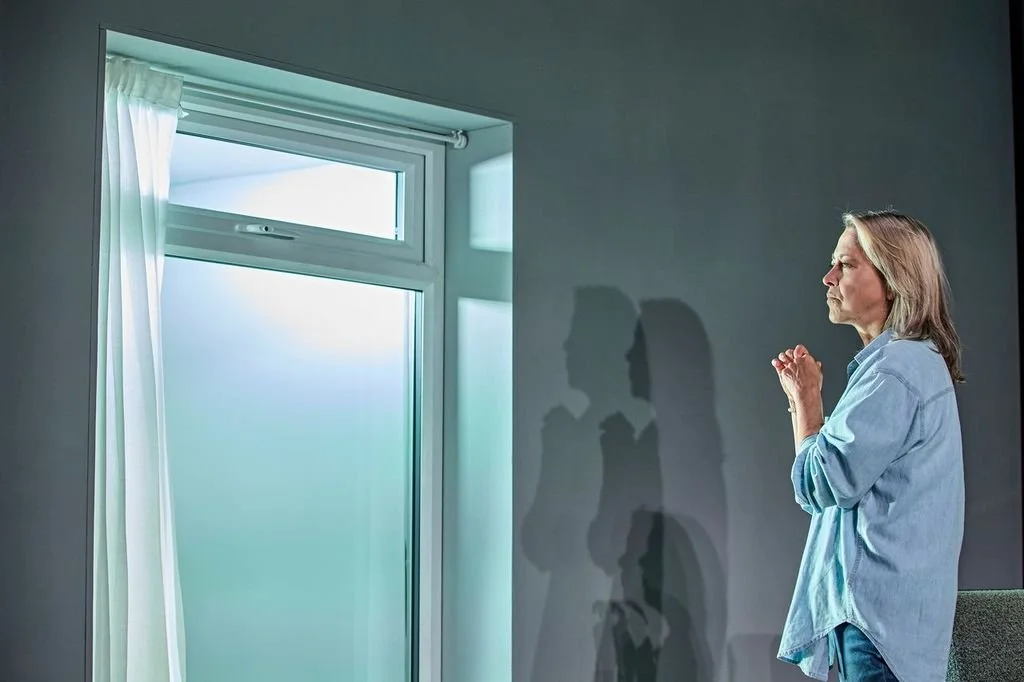
While the entire ensemble cast delivers superb performances, it is Walker’s captivating portrayal of Miriam that truly anchors the production. Although the character is caught in a cycle of grief and obsession over Oscar’s disappearance, Walker’s portrayal never becomes one-note. She finds an impressive range of ways to embody Miriam’s anger, hope, hopelessness, and feelings of betrayal toward those around her who she perceives as having given up or not putting enough effort into the ongoing search for her son.
Payne’s writing balances well-crafted, gripping drama with moments of humour that feel even sharper due to their proximity to the surrounding devastation. Comedy often arises from the family bickering over minutiae, and there’s one particularly memorable scene in which Harry Kershaw’s character, Benjamin, displays a painful inability to read the room as he enthusiastically shares his knowledge about puffins. The result is genuinely hilarious, as the tension in the room builds and builds unnoticed by him until it finally explodes dramatically.
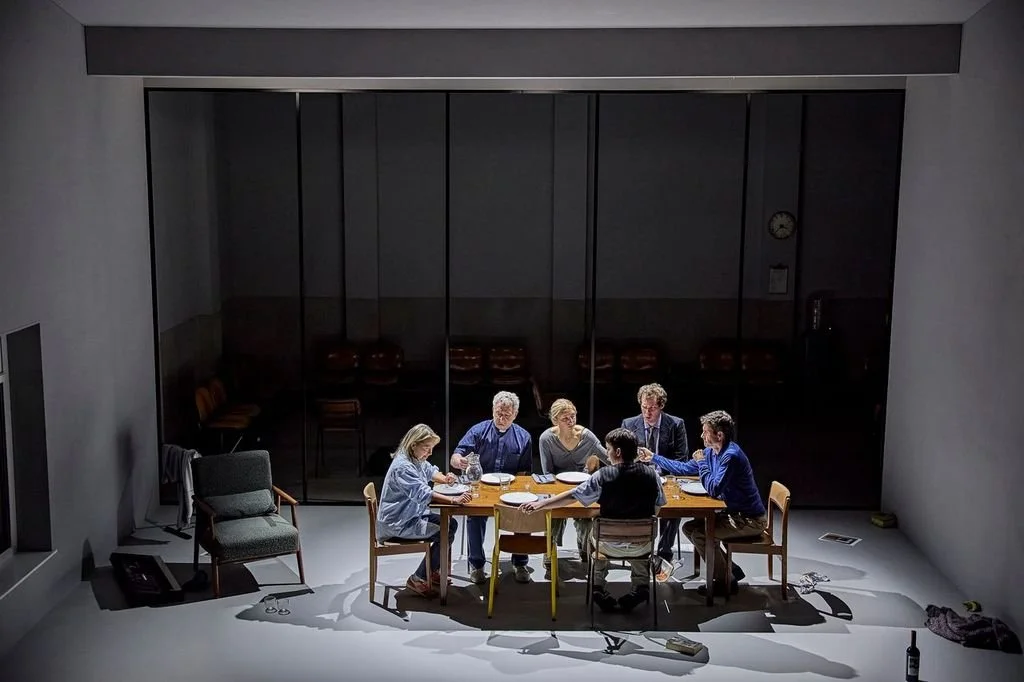
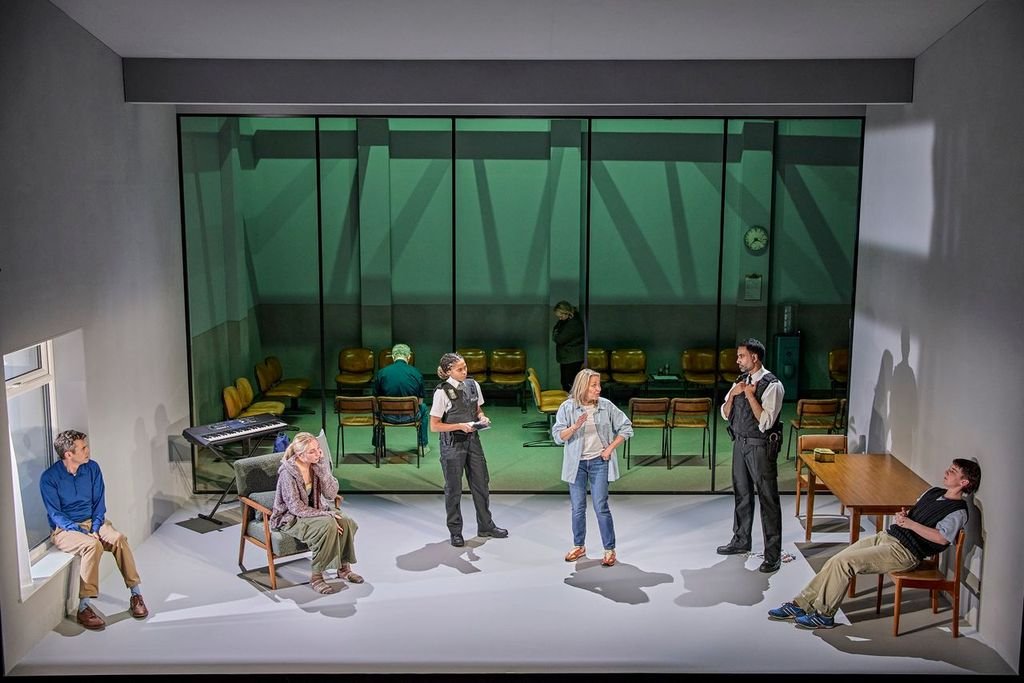
Elliott’s direction and Bunny Christie’s set design add an extra layer of poignancy to Payne’s writing. The front half of the stage serves as the main playing space, and with its stark white walls and sparse furniture, the Wright residence feels more like a hospital or mental health institution than a family home: a choice that may suggest Miriam’s true location, depending on your interpretation of the play. Behind this, a waiting room filled with chairs houses the characters not currently involved in the scene taking place, symbolising the state of purgatory they all inhabit: caught between grief and the hope that Oscar (or at least some information about his disappearance) might still be found. While in the waiting room, the cast remain in character, either staring into the distance in contemplation or fixing their gaze intensely on Miriam, leaving us to wonder how much of what we are seeing is taking place within her grief-addled mind. The way in which The Unbelievers doesn’t provide all the answers but allows the audience to draw their own conclusions is one of the elements that keeps the play so engaging.
However, while the ambiguity in certain aspects of the play is effective, greater clarity in signposting the timeline would make The Unbelievers more satisfying to watch. Although transitions between scenes are marked by Jack Knowles’ lighting design and Nicola T. Chang’s sound design, it isn’t always clear which point in time we’ve moved to. A stronger visual cue, such as changes in the characters’ clothing, could help the audience orient themselves more easily rather than spending much of each new scene trying to work out which timeline they are currently watching.
Overall, The Unbelievers is highly watchable and, despite its one-hour-fifty-minute runtime without an interval, remains thoroughly engrossing throughout. The play could benefit from clearer differentiation between timelines, but this is more than compensated for by the strength of its writing, direction, and performances.
The Unbelievers runs at Royal Court Theatre until 29th November 2025.
Photos by Brinkhoff Moegenburg